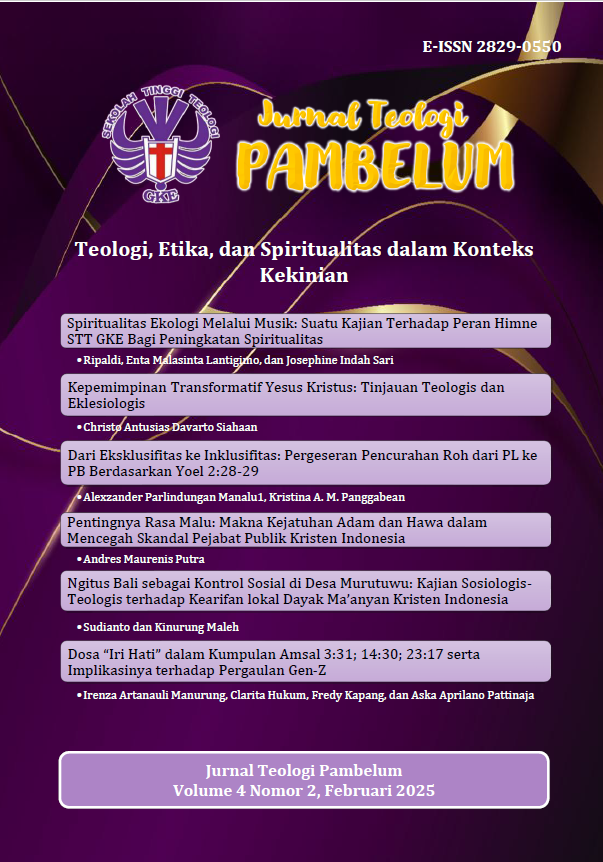
Dosa “Iri Hati” dalam Kumpulan Amsal 3:31; 14:30; 23:17 serta Implikasinya terhadap Pergaulan Gen-Z
DOI:
https://doi.org/10.59002/jtp.v4i2.110Keywords:
Proverbs, Envy, Gen-Z, Implications, DeclineAbstract
The sin phrase "envy" appears only three times in the entire book of Proverbs, namely Proverbs 3:31; 14:30; 23:17, and this sin has a very negative impact on Gen-Z because it can trigger behavior without ethics and morals. In the literature search, there is a research gap in discussing this sin specifically and comprehensively because the discussion is often combined in wisdom advice and book structure. The purpose of this study is to specifically and comprehensively analyze this sin and its negative impact on the spiritual development of Gen-Z. Based on the hermeneutic method of the subgenre of wisdom literature, this study found that there are four negative effects, namely: first, destructive comparisons; second, emotional health problems; third, spiritual deterioration; and fourth, damaged relationships. This research is a contribution for counselors and educators to better understand and reach out to Gen-Zs who are bound by the sin of envy.
References
Brown, F., Driver, S. R., & Briggs, C. A. (2015). A Hebrew and English Lexicon of the Old Testament, with an Appendisx Containing The Biblical Aramaic (F. Brown, S. R. Driver, & Charles A Briggs (eds.); 5th ed.). Oxford University Press.
Bruce K. Waltke. (2014). The Book of Proverbs Chpter 1-15 (The New International Commentary on the Old Testament) (R. K. Harrison & J. Robert L Hubbard (eds.)). William B. Erdmans Publishing Company.
Bullinger, E. W. (2015). Figures of Speech Used in the Bible: Explained and Illustrated. In G. Anderson (Ed.), The American Journal of Theology. Messrs. E & J. B. Young & Co. https://doi.org/10.1086/477604
Colmekcioglu, N., Dedeoglu, B. B., & Okumus, F. (2023). Resolving the complexity in Gen Z’s evy occurence: A cross cultural perspective. Journal Psikology & Marketing, 40(1), 48–72. https://doi.org/https://doi.org/10.1002/mar.21745
Crusius, J., & Lange, J. (2014). What catches the envious eye? Attentional biases within malicious and benign envy. Journal of Experimental Social Psychology, 55(2), 1–11. https://doi.org/10.1016/j.jesp.2014.05.007
Douglas Stuart. (2020). Eksegese Perjanjian Lama (2nd ed.). Gandum Mas.
Ellen F. Davis. (2000). Proverbs, Ecclesiastes, Song of Songs (P. D. Miller & D. L. Bartlett (eds.); 1st ed.). Westminster John Knox Press.
Ellis, A. (2023). The Rot of the Bones: A New Analysis of קנאה (“Envy/Jealousy”) in the Hebrew Bible. Journal of Biblical Literature (JBL), 142(3), 385–408. https://doi.org/https://doi.org/10.15699/jbl.1423.2023.2
Goldingay, J. (2013). Old Testament Theology: Israel’s Life. IVP Academic.
Grant R Osborne. (2021). Spiral Hermeneutika - Pengantar Komprehensif Bagi Penafsiran Alkitab (Stevy Tilaar (ed.)). Momentum.
Greenstone, J. H. (2016). The Wisdom Literature and the Psalms: A Theological Introduction. Harper & Row.
Jan Keefer, A. (2021). The Book of Proverbs and Virtue Ethics - Integrating the Biblical and Philosophical Traditions. In Eton College (Ed.), The Book of Proverbs and Virtue Ethics (1st ed.). Cambridge University Press. https://doi.org/10.1017/9781108885119
Joubert, C. (2018). Genesis 4:8 : why did Cain murder his brother? The Journal of the South African Theological Seminary, 26(1), 99–113.
Kannan, L., & Kumar, T. P. (2022). Social Media—The Emotional and Mental Roller-Coaster of Gen Z: An Empirical Study. In B. R. Rajagopal (Ed.), Managing Disruptions in Business. Palgrave Studies in Democracy, Innovation, and Entrepreneurship for Growth. (pp. 82–101). Palgrave Macmillan, Cham. https://doi.org/https://doi.org/10.1007/978-3-030-79709-6_4
Klein, W. W., Blomberg, C. L., & Hubbard, R. L. (2017). Introductionn Biblical Interpretation 2 (C. Jusuf (ed.); 2nd ed.). Literatur SAAT.
Koptak E, P. (2013). PROVERBS - The NIV Application Commentary. Zondervan.
Kotzé, Z. (2024). Leah’s ‘soft’ eyes: Unveiling envy and the evil eye in Genesis 29:17. HTS : Theological Studies, 80(1). https://doi.org/https://doi.org/10.4102/hts.v80i1.9536
Lange, J., & Crusius, J. (2015). Dispositional Envy Revisited. Personality and Social Psychology Bulletin, 41(2), 284–294. https://doi.org/10.1177/0146167214564959
Lappenga, B. (2017). James 3:13–4:10 and the Language of Envy in Proverbs 3. Journal of Biblical Literature (JBL), 136(4), 989–1006. https://doi.org/https://doi.org/10.15699/jbl.1364.2017.200534
Lindsay Wilson. (2017). Proverbs An Introducton and Commentary (Tyndale Old Testament Commentaries) (D. G. Firth & Tremper Longman III (eds.); 17th ed.). Inter Varsity Press.
Michael V. Fox. (2009). The Ancor Bible Proverbs 10-31 A New Translation with Introduction and Commentary (The Anchor, Issue 18B). Yale University Press.
Murphy, R. E. (2000). The Tree of Life: An Exploration of Biblical Wisdom Literature. Doubleday Published.
Pattinaja, A. A. (2024). Keterkaitan “takut akan tuhan” dan “ membenci kejahatan” terhadap pembentukan karakte r: kajian hermeneutik berdasarkan amsal 8:13. Ekklesia: Jurnal Teologi Dan Pendidikan Kristiani, 3(1), 1–20. https://ojs.sttekklesiaptk.ac.id/index.php/ekklesia/article/view/73
Pattinaja, A. A., & Pattianakotta, V. (2024). Seven Principles of Anatomical Pedagogy in Proverbs : A Hermeneutic Study of Numerical Proverbs Based on Proverbs 6 : 16-19. Predica Verbum: Jurnal Theologi and Mission, 4(2), 96–113. https://doi.org/10.1515/9781575063614-021/html.2
Pattinaja, A. A., & Suhun, W. (2024). Antitesis Orang Jujur dan Orang Fasik Dalam Pembentukan Karakter Pemimpin: Studi Eksegesis Amsal 11:11. VIEWS : Jurnal Teologi & Biblika, 2(1), 80–99. https://penerbitviekawahanasemesta.com/index.php/views/article/view/aska_2024
Pattinaja, A., Puryana, Z., & Sualang, F. Y. (2023). Antitesis Pola Perkataan Karakter-Konsekuensi pada Amsal 28:20 sebagai Kualitas Hidup Orang Percaya dalam Mengatasi Judi Online. SANCTUM DOMINE: JURNAL TEOLOGI, 13(1), 113–134. https://doi.org/10.46495/sdjt.v13i1.212
Robert Alter. (2017). The Wisdom Books (1st ed.). W W Norton & Company. Inc. https://doi.org/10.5040/9780567701145.part-004
Sin, S. K. (2018). Pendekatan topikal dalam menafsirkan kitab amsal. Jurnal Theologi Aletheia, 20(14), 1–27.
Smith, R. H., & Kim, S. H. (2007). Comprehending envy. Psychological Bulletin, 133(1), 46–64. https://doi.org/10.1037/0033-2909.133.1.46
Smith, R. H., Parrott, W. G., Diener, E. F., Hoyle, R. H., & Kim, S. H. (2016). The psychology of envy. Journal of Personality and Social Psychology, 111(5), 800–816.
Sonny Eli Zaluchu. (2021). Metode Penelitian di dalam Manuskrip Jurnal Ilmiah Keagamaan. Jurnal Teologi Berita Hidup, 3(2), 249–266. https://doi.org/https://doi.org/10.38189/jtbh.v3i2.93
Stahl, C. C., & Literat, I. (2022). GenZ on TikTok: the collective online self-Portrait of the social media generation. Journal of Youth Studies, 26(7), 925–946. https://doi.org/https://doi.org/10.1080/13676261.2022.2053671
Stuart, D., & Fee, G. D. (2021). Hermeneutik - Menafsirkan Firman Tuhan Dengan Tepat (Yosua Setio Yudo (ed.); 4th ed.). Gandum Mas.
Sualang, F. Y. (2019). Prinsip-Prinsip Hermeneutika Genre Hikmat dalam Kitab Amsal: Suatu Pedoman Eksegesis. Jurnal PISTIS, 1(1), 93–112. https://doi.org/10.31227/osf.io/xmk6h
Sualang, F. Y. (2023). Suatu Kajian Mengenai Keterkaitan Faktor-Faktor Pembentukan Karakter dalam Kitab Amsal. HUPERETES: Jurnal Teologi Dan Pendidikan Kristen, 4(2), 91–108. https://doi.org/10.46817/huperetes.v4i2.171
Tremper Longman III. (2015). Hikmat dan Hidup Sukses (Paul Hidayat (ed.)). Scripture Union Indonesia.
Tremper Longman III. (2017). Proverbs - Baker Commentary on the Old Testament Wisdom and Psalms (Tremper Longman III (ed.)). Baker Academic Publishing Group. www.bakeracademic.com
Twenge, J. M., & Campbell, W. K. (2010). The Narcissism Epidemic: Living in the Age of Entitlement. Free Press.
Waltke, B. K., & De Silva., I. D. V. (2021). Proverbs: A Shorter Commentary. William B. Erdmans Publishing Company. https://doi.org/10.5325/bullbiblrese.33.1.0093
William L. Holladay. (2019). A Concise Hebrew and Aramaic Lexicon of The Old Testament (3rd ed.). William B. Erdmans Publishing Company.
Downloads
Published
How to Cite
Issue
Section
License
Copyright (c) 2025 Irenza Artanauli Manurung, Clarita Hukum, Fredy Kapang, Aska Aprilano Pattinaja

This work is licensed under a Creative Commons Attribution 4.0 International License.